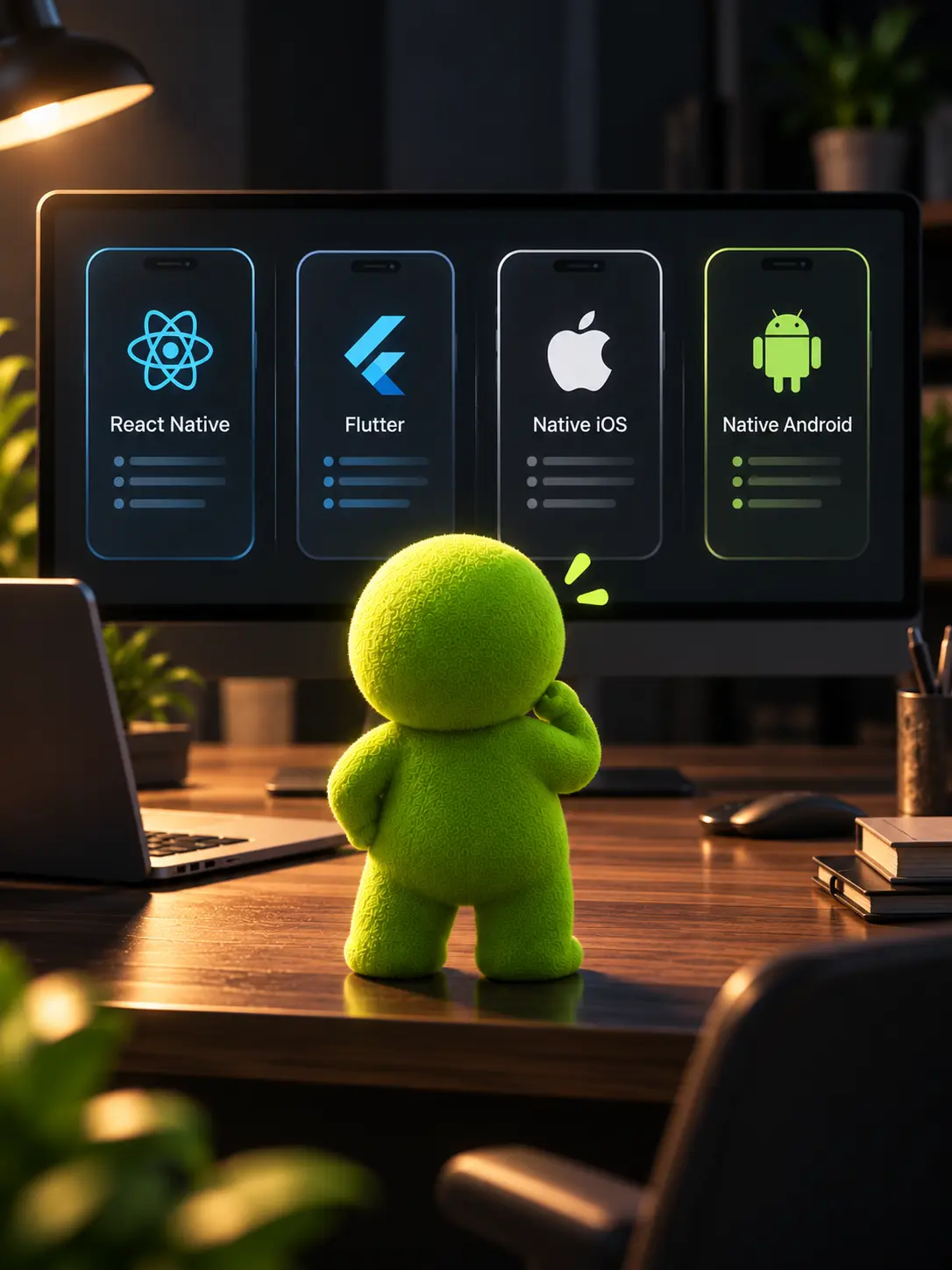
Native vs. Cross-Platform: Choosing the Right Mobile Stack
A pragmatic engineering guide for founders and technical leaders evaluating React Native, Flutter, and Native Swift/Kotlin to balance speed-to-market with long-term code maintainability.

There is no universal best mobile stack—only the architecture that best fits your product’s hardware demands, runway, and iteration cadence.
One of the most consequential decisions facing any startup or enterprise mobile initiative is whether to build native iOS and Android apps separately or consolidate behind a cross-platform framework. Choosing incorrectly can burn hundreds of thousands of dollars in technical rewrites or slow product iteration down to a crawl.
At codenora labs, we have architected and deployed mission-critical apps across both native and cross-platform stacks. Here is our direct, unbiased evaluation.
The Three Dominant Mobile Paradigms
1. React Native (Fabric Architecture)
Backed by Meta, React Native compiles JavaScript/TypeScript into genuine native UI components. With the new Fabric C++ architecture and Hermes JavaScript engine, bridge latency is virtually non-existent. It is ideal for teams with existing TypeScript/React talent seeking a shared codebase across web and mobile.
2. Flutter (Skia / Impeller Rendering)
Google’s Flutter draws every pixel directly onto a 2D graphics canvas using Dart and the Impeller rendering engine. It delivers unmatched UI consistency across iOS, Android, and desktop, making it the favorite for highly bespoke, animated interfaces and uniform branded aesthetics.
3. Pure Native (Swift / Kotlin)
Swift (iOS) and Kotlin (Android) remain the undisputed gold standard for hardware-intensive applications requiring direct CoreBluetooth, CoreML, ARKit, or heavy background sensor processing where third-party abstraction layers introduce instability.
Strategic Decision Matrix
How we advise our partners on stack selection:
- Choose Cross-Platform if: You need to validate product-market fit on both iOS and Android simultaneously, have a unified product roadmap, or want 70–80% shared business logic to cut development and maintenance costs in half.
- Choose Pure Native if: Your app relies heavily on real-time biometric sensors, custom Bluetooth LE peripherals, high-frame-rate 3D rendering, or requires day-one support for new OS-level APIs on launch day.
Summary
Modern cross-platform development has matured to the point where 90% of business applications gain massive economic advantages from frameworks like React Native or Flutter without sacrificing perceptible performance.